Canyon Run
Read the current prompt
Role: You are an expert Three.js and WebGL game developer specializing in high-performance, minimalist arcade racers.

Objective: Create an HTML5 game (HTML/CSS/JS) that is a "High-Speed Procedural Canyon Racer." The gameplay must mimic the "flow" and "tension" of Race the Sun.

1. Core Gameplay Mechanics (The "Feel")
Movement Physics: Implement a "flight-based" physics model rather than direct axis control. The player (a sleek, low-poly geometric craft) should have momentum, banking (rolling) during turns, and pitch-based acceleration. Movement should feel "weighty" but highly responsive.
The Risk/Reward System (Proximity Scoring): Implement a "Near-Miss" mechanic. The closer the player passes to canyon walls or obstacles without colliding, the higher the score multiplier becomes.
Energy/Fuel Mechanic: The player has a constant "energy decay." Collecting glowing geometric orbs (recharges) is essential to stay alive. This forces the player to take risky paths through narrow gaps to stay fueled.
Speed & Acceleration: Implement a "Boost" system. Collecting items or maintaining high-speed straightaways builds a "Turbo" meter that allows for temporary extreme velocity and visual FOV widening.
2. Procedural Environment Generation
Infinite Generation: Use a chunk-based procedural generation system. As the player moves forward, generate new canyon segments and destroy old ones to ensure the game runs infinitely without memory leaks.
Terrain Variety: Generate three types of obstacles:
Canyon Walls: Massive, sweeping geological formations.
Floating Monoliths: Large, geometric pillars that require banking to avoid.
Tight Squeezes: Narrow gaps that require precise pitch/roll control.
Difficulty Scaling: As the score increases, increase the speed of the player and the density/tightness of the procedural obstacles.
3. Visual Direction (Aesthetic & Atmosphere)
Art Style: "Minimalist Low-Poly." Use a highly stylized, geometric aesthetic. No textures; use flat shading or simple vertex colors.
Lighting & Color Palette: Use a "Golden Hour" or "Cyber-Sunset" palette (deep oranges, purples, and silvers). Implement dramatic, long shadows cast by the canyon walls.
Post-Processing Effects (via Three.js):
Bloom: To make the energy orbs and the craft’s engine glow.
Motion Blur: To simulate extreme speed.
Camera Shake: Subtle shake when passing very close to walls or during high-speed boosts.
Particle Systems: Add a "trail" effect behind the player craft and "dust" or "debris" particles that fly past the player to emphasize speed.
4. HUD & User Interface
Minimalist HUD: The HUD should be non-intrusive.
Speedometer: A sleek, thin line representing current velocity.
Multiplier Counter: A large, stylized number that pulses when a "Near-Miss" is detected.
Energy Bar: A glowing bar (possibly circular around the player or at the bottom) that depletes and refills.
Game Over Screen: A clean, high-contrast overlay showing "Final Score," "Max Speed," and a "Restart" button.
5. Technical Requirements
Frameworks: Use Three.js for 3D rendering (include Three.js via CDN).
Performance: Use requestAnimationFrame. Optimize geometry to ensure a smooth 60fps on most hardware.
Collision Detection: Implement efficient bounding-box or sphere-based collision detection between the player and the procedural geometry.
Sound Synthesis: Use the Web Audio API to generate procedural sound effects (a low hum for the engine, a "ping" for collectibles, and a synthesized "whoosh" for near-misses).
Recent highlights
Latest results
Screenshot unavailable
Canyon Run
Swift Qwen3.8 27B GGUF
Screenshot unavailable
Canyon Run
Mimo v2.6 Flash
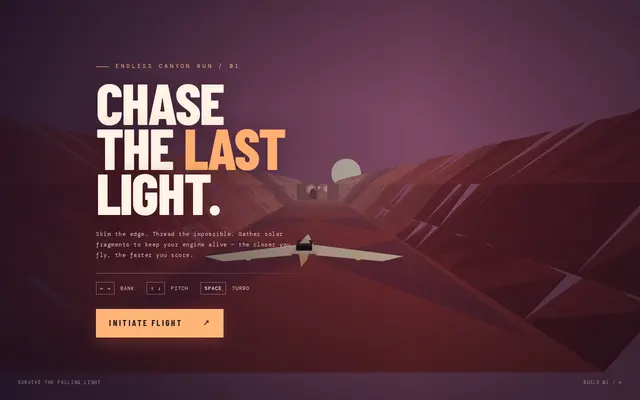
Canyon Run
GPT 6 Sol
Screenshot unavailable
Canyon Run
GPT 6 Luna
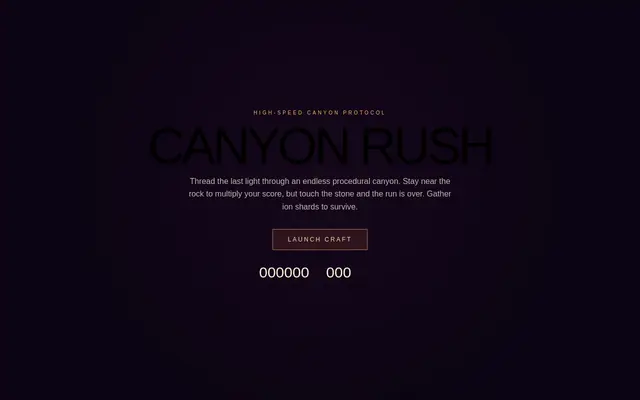
Canyon Run
nex agi Nex N2.5 mini GGUF
Screenshot unavailable
Canyon Run
Deepseek v4.1 Flash
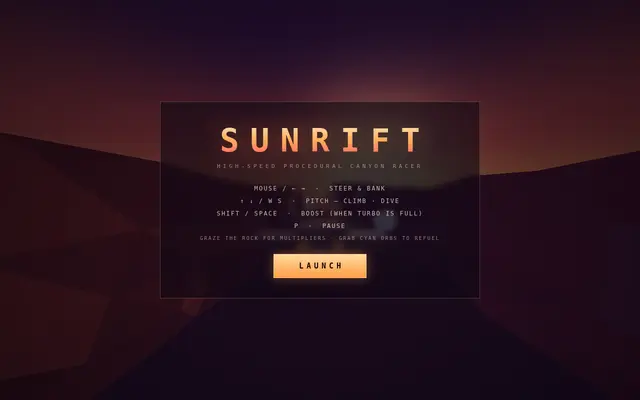
Canyon Run
Qwen 3.8
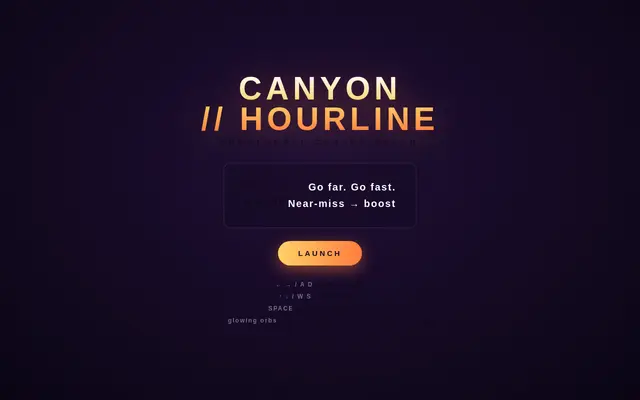
Canyon Run
Tiel Coder 35B A3B GGUF MTP
Screenshot unavailable
Canyon Run
Qwen 3.8
Screenshot unavailable
Canyon Run
GLM 5.3 Flash
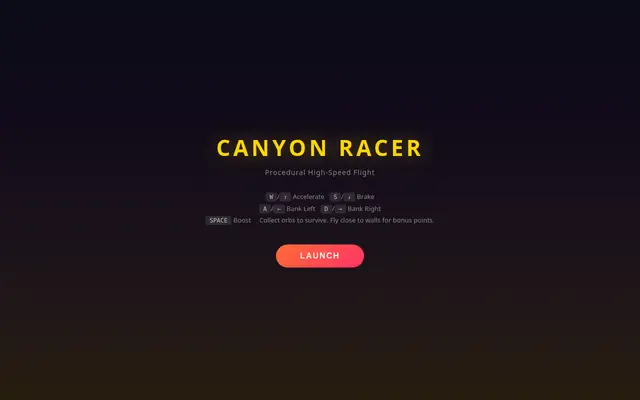
Canyon Run
ling 3.0 Flash
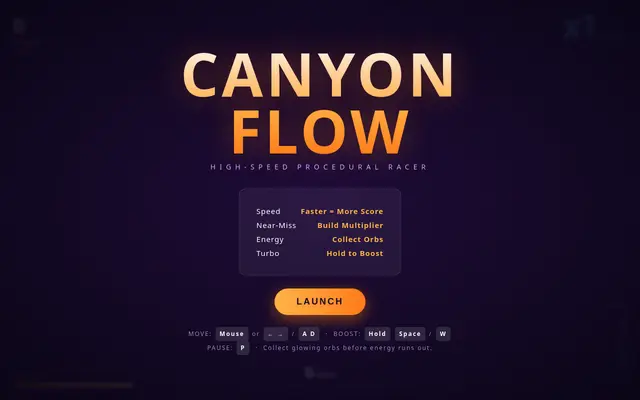
Canyon Run
Ornith 1.5 35B A3B
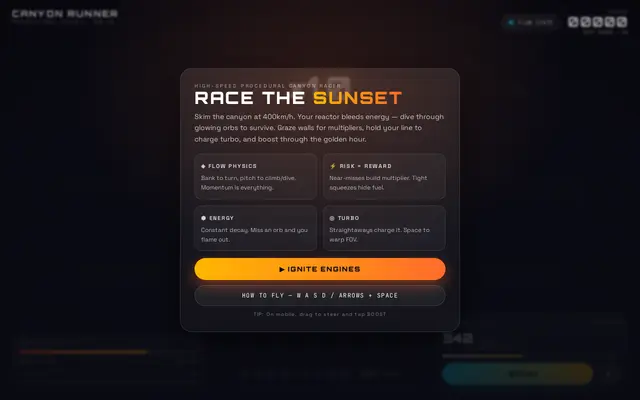
Canyon Run
muse spark 1.2 contributor
Screenshot unavailable
Canyon Run
ox alpha
Screenshot unavailable
Canyon Run
Gemini 3.7 Flash
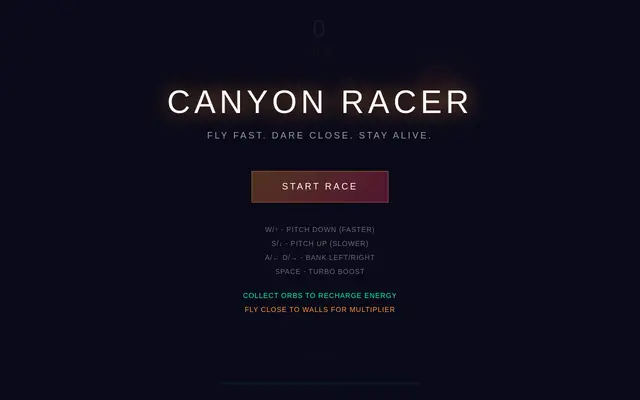
Canyon Run
seed 2.0 code
Screenshot unavailable
Canyon Run
Qwen 3.8 27B GGUF
Canyon Run
ling 3.0 tiny:free