Flight Simulator
Read the current prompt
This prompt is designed to be given to an AI model or a development team to establish a clear, high-fidelity goal for building the simulator. It emphasizes technical constraints and the critical importance of realistic physics.

***

# 🚀 Three.js Flight Simulator Prompt: Apex Aero

## 🎯 Project Goal
Design and develop a high-fidelity, physically accurate 3D flight simulator implemented entirely in HTML using **Three.js** (or a compatible framework like Babylon.js) and pure JavaScript/TypeScript. The core experience must prioritize realistic aerodynamics, inertial forces, and challenging gameplay across diverse scenarios.

## 🛠️ Technical Stack & Core Requirements
1.  **Engine:** Three.js (mandatory for all rendering and scene management).
2.  **Language:** JavaScript/TypeScript.
3.  **Physics Engine:** Implement a custom, highly detailed Newtonian physics model that simulates flight dynamics realistically (not just simple linear movement).
4.  **Input:** Mouse/Keyboard controls for pitch, roll, yaw, throttle, and thrust management.

## ✨ Feature Breakdown

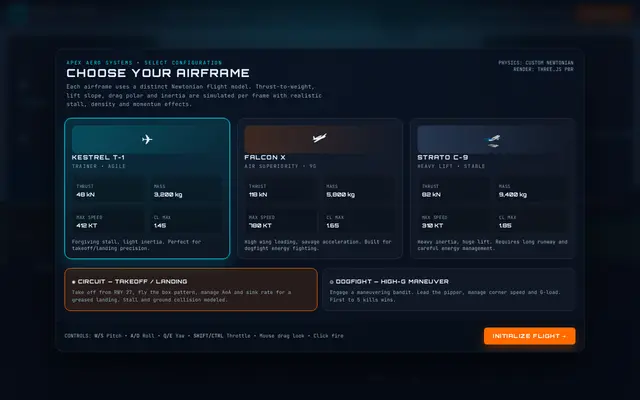
### 1. Aircraft Selection & Differentiation (The Fleet)
Implement a minimum of **three distinct aircraft models**. These planes must possess mathematically differentiated attributes that directly affect flight physics:

*   **Attribute Examples:** Max Speed, Thrust/Engine Power, Lift Coefficient, Drag Profile, Turning Radius, Weight, and Maneuverability Response.
*   **Visuals:** Each plane must have a unique, high-quality 3D model.

### 2. Terrain Generation (The World)
*   **Procedural Generation:** The environment must be procedurally generated to create vast, varied, and visually stunning landscapes (mountains, valleys, coastlines).
*   **Detail:** Implement complex geometry with accurate heightmaps and texture mapping to ensure realistic visual scale and topographical awareness for the pilot.
*   **Collision Detection:** Terrain interaction must accurately reflect ground friction and altitude constraints.

### 3. Gameplay Scenarios (The Missions)
The game must include two primary, distinct gameplay modes:

#### A. Takeoff/Landing Scenario (Precision Flight)
*   Focus on managing altitude, airspeed, and engine power precisely.
*   Requires accurate simulation of lift-off physics, climb rates, descent control, stall limits, and runway requirements based on the chosen aircraft's weight and performance characteristics.

#### B. Dogfight Scenario (High-Speed Maneuvering)
*   Focus on high-G maneuvering, managing speed, angle of attack, and inertia in a dynamic combat environment.
*   Requires accurate simulation of slipstream effects, banking dynamics, and the physical limits of the aircraft during aggressive turns and evasive maneuvers.

## 🔬 Physics & Fidelity (The Critical Focus)
**This is the single most important requirement.** The game must feel *physically accurate* and challenging.

1.  **Aerodynamics:** Implement realistic drag calculation (profile drag vs. induced drag), lift generation based on angle of attack, and realistic air density effects based on altitude.
2.  **Inertia & Momentum:** Aircraft movement must account for inertia. Sudden changes in direction or thrust must result in realistic lag, pitch/roll response time, and momentum carry-over.
3.  **Engine Response:** Throttle input must accurately translate to force, RPM changes, engine heat/stress (optional visual feedback), and realistic acceleration rates based on the plane's power-to-weight ratio.
4.  **Atmospheric Effects:** Altitude must affect air density and performance; this effect must be consistent across all scenarios.

## 🎧 Audio Immersion
Sound design is mandatory for full immersion. The audio experience must be dynamic and directly linked to the physics calculations.

*   **Engine Sound:** Engine noise, pitch, and volume must change realistically based on throttle input, RPM, acceleration, and altitude (accounting for air density).
*   **Aerodynamic Sounds:** Implement realistic sound effects for airflow over the wings and control surfaces (e.g., whistling or roaring based on speed/angle of attack).
*   **Environmental Audio:** Include dynamic ambient sounds that reflect the environment (e.g., wind noise increasing at higher altitudes, distant rumble of mountains).

## 🎨 Aesthetic & User Experience
*   **Visual Style:** Cinematic, high-definition realism. Use modern lighting techniques (PBR materials) to enhance the visual beauty of the procedural terrain.
*   **UI/HUD:** The Heads-Up Display (HUD) must clearly display critical flight data (Altitude, Airspeed, Pitch, Roll, Engine Status) in a clean, intuitive format.

## ✅ Deliverables Summary
The result should be an interactive application demonstrating:
1.  A fully functional Three.js scene with procedurally generated terrain.
2.  Three selectable aircraft with distinct physics profiles.
3.  Functional controls for realistic flight dynamics.
4.  Working Takeoff/Landing and Dogfight scenarios, demonstrating the accurate interaction of the defined physics models.
Recent highlights
Latest results
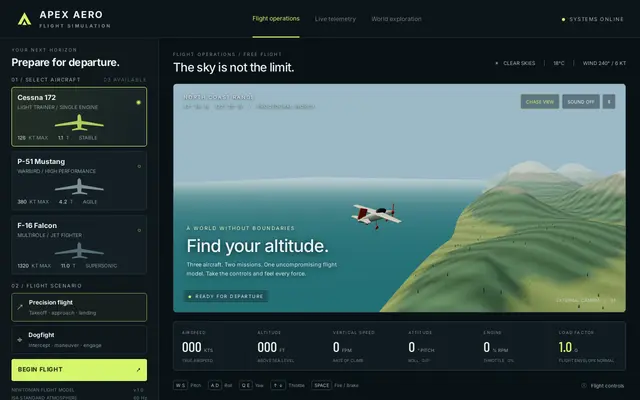
Flight Simulator
GPT 6.1 Sol
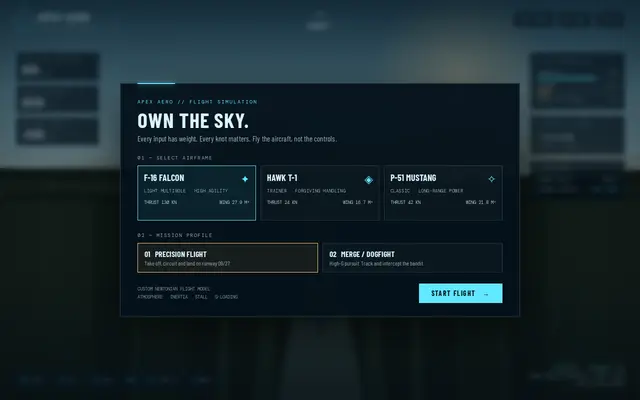
Flight Simulator
GPT 6 Luna
Screenshot unavailable
Flight Simulator
GPT 6 Sol
Screenshot unavailable
Flight Simulator
Grok 4.7
Flight Simulator
Mimo v2.6 Flash
Flight Simulator
Mimo v2.6 Pro
Screenshot unavailable
Flight Simulator
Deepseek v4.1 Flash
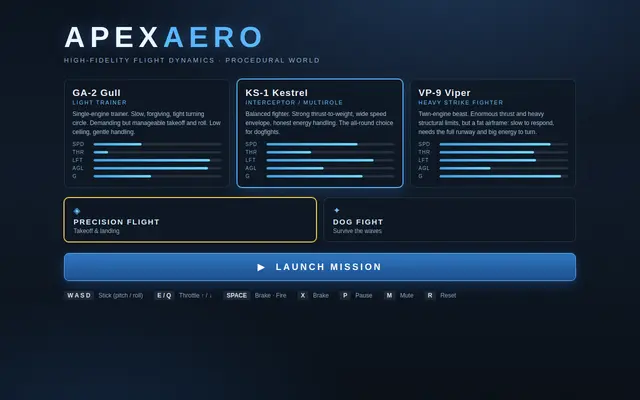
Flight Simulator
Qwen 3.8
Screenshot unavailable
Flight Simulator
GPT 6 Astra
Screenshot unavailable
Flight Simulator
Tiel Coder 35B A3B GGUF MTP
Screenshot unavailable
Flight Simulator
Qwen 3.8
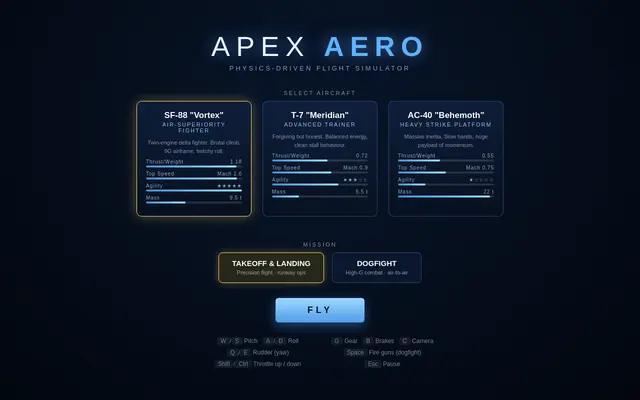
Flight Simulator
GLM 5.3 Flash
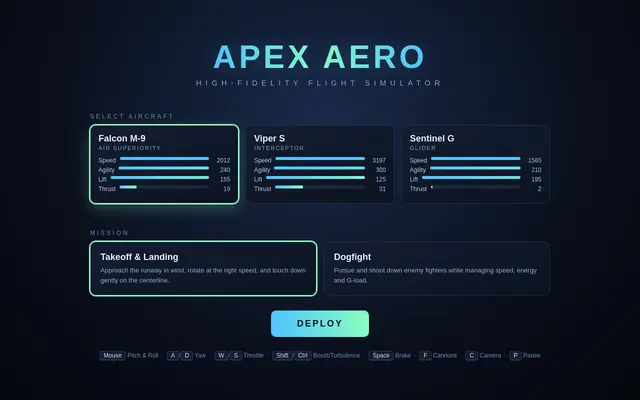
Flight Simulator
Ornith 1.5 35B A3B
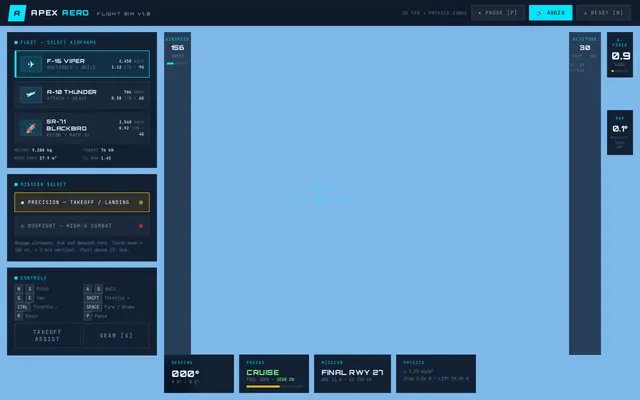
Flight Simulator
muse spark 1.2 contributor
Screenshot unavailable
Flight Simulator
ox alpha
Screenshot unavailable
Flight Simulator
Qwen 3.8 27B GGUF
Flight Simulator
muse spark 1.2
Screenshot unavailable
Flight Simulator
muse spark 1.2