Gorillaz
Read the current prompt
Game Spec — "Gorillaz" (Artillery Clone)

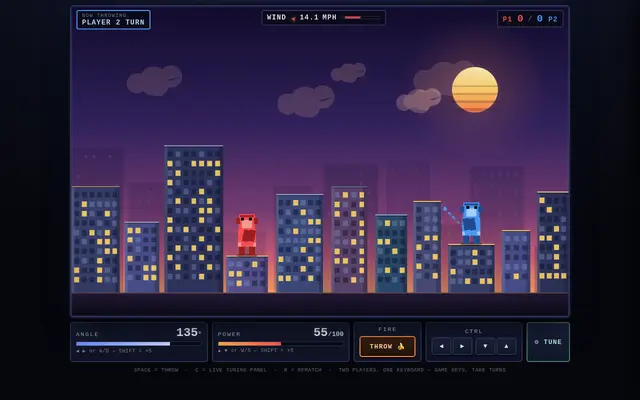
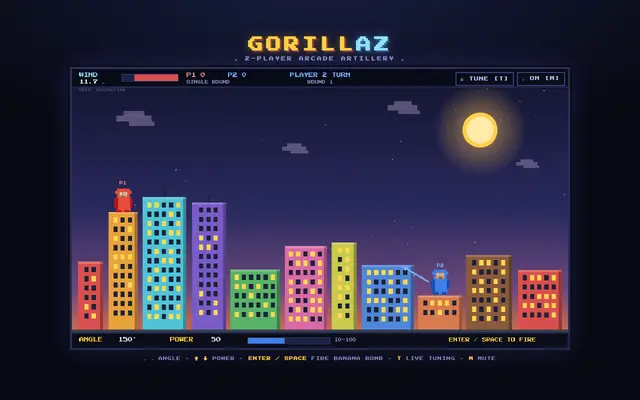
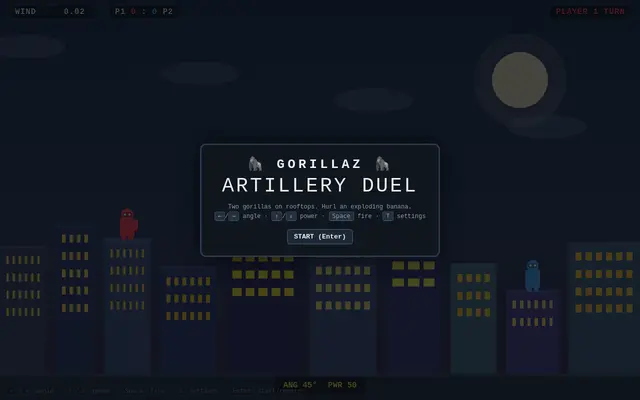
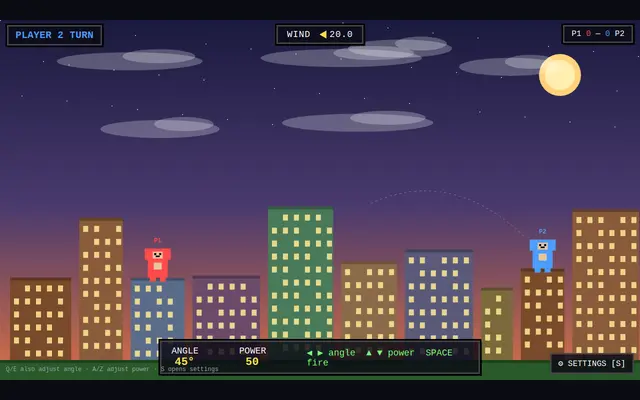
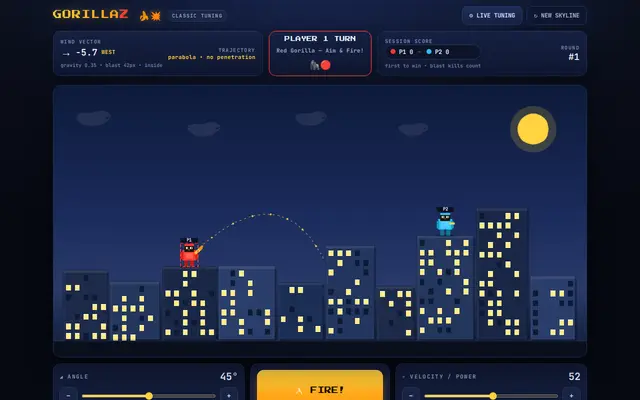
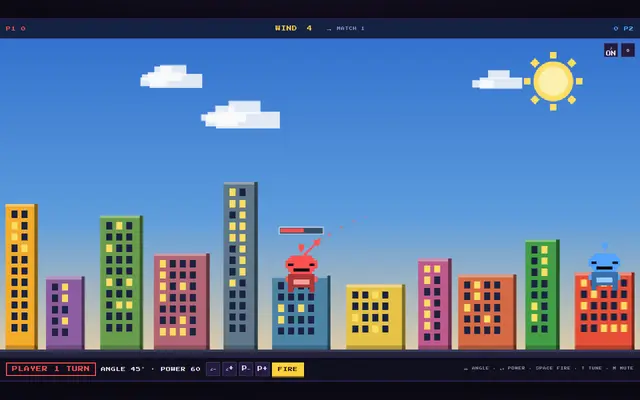
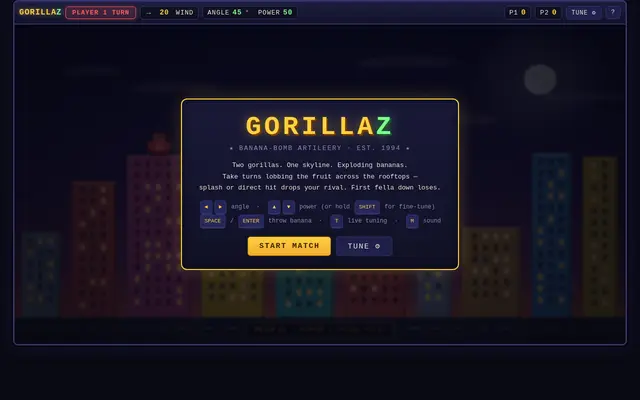
Concept & Overview A two-player, turn-based physics artillery game. Each match takes place on a randomly generated urban skyline. Two gorilla characters stand atop separate buildings and take turns hurling an explosive projectile—styled as a banana—at each other. The first gorilla eliminated by blast or direct impact loses the round.

Players & Setup

Exactly two human players; local turn-based only.
At match start, generate a fresh city skyline composed of rectangular buildings of random widths and heights arranged along a flat ground line.
Place one gorilla on the roof of a randomly selected left-side building and the other on a randomly selected right-side building, ensuring neither starts inside blast range of the other.
Core Loop (Per Turn)

Active player receives control.
Player sets two independent values: launch angle (direction/arc) and throw velocity/power.
The projectile launches along a ballistic trajectory influenced by constant downward gravity and a visible, variable wind vector (speed and horizontal direction).
The projectile travels until it intersects a building, the ground, or the opposing gorilla.
On intersection, trigger an explosion with a fixed circular blast radius.
If the opposing gorilla is within the blast radius or struck directly, that player is eliminated and the active player wins the match.
If no elimination occurs, the turn passes to the opponent. Wind may shift randomly between turns or remain constant per match rules—specify visible wind indicator updates after each turn.
Physics & Combat Rules

Ballistic arc: projectile path is a parabola modified by gravity.
Wind: horizontal force applied continuously during flight; display current wind speed and left/right direction in a persistent HUD element.
Collision: projectile collides with building edges/roofs and ground plane. Buildings do not take damage or alter shape from explosions.
Explosion: circular damage zone centered on impact point. No chain reactions.
Direct hit and splash damage both count as a kill.
Environment

Procedural skyline: 8–14 buildings, random heights within a defined min/max range, random widths with small gaps between them.
Flat ground plane across the bottom.
Static background: sky gradient, a simple sun/moon graphic, and decorative clouds (optional, non-interactive).
No scrolling; entire playfield visible in a single screen frame.
Visual Style

Retro arcade aesthetic: blocky buildings in flat, high-contrast colors; simple pixel-art or vector-style gorilla sprites with minimal animation (idle stance, win/loss reaction).
Projectile rendered as a small curved sprite with motion trail.
Explosion rendered as an expanding radial circle with brief particle/dust effect, then a lingering scorch marker (optional).
Buildings colored distinctly per structure; gorillas color-coded to match player identity (e.g., red vs. blue).
User Interface / HUD

Top bar: current wind speed and directional arrow/indicator.
Turn indicator: clearly labeled “Player 1 Turn” / “Player 2 Turn.”
During aiming/input phase: display current angle value and velocity/power value being set, updating in real time as the player adjusts.
Score tracking: number of rounds won per player across multiple consecutive matches (optional persistent session score).
Controls (Input Specification)

Each player uses the same input device in sequence, or separate input mappings if hardware allows.
Angle control: increment/decrease launch angle in discrete steps or continuous adjustment.
Velocity control: increment/decrement throw power on a defined scale (e.g., 1–100).
Confirm/fire button to execute the throw with current values.
No pause/menu system required other than a “New Match / Rematch” prompt after a win.
Win Condition & Session Flow

Single round ends immediately upon one gorilla being eliminated.
After round resolution, display winner and offer rematch with a new randomly generated skyline.
Optional: best-of-three or best-of-five session mode.
Audio Design (Optional but Specified)

Launch sound on throw execution.
Impact/explosion sound on collision.
Brief victory fanfare or gorilla vocalization on round end.
Subtle wind ambience or tone reflecting current wind strength.
Live Configuration / Runtime Tuning The game must expose a live-editable configuration layer—accessible via an in-game settings panel, overlay menu, or dedicated tuning screen—that allows direct modification of internal constants equivalent to those originally hardcoded in the source file. Changes apply immediately or take effect on the very next turn/projectile launch without requiring a restart or recompilation.

Required configurable values (minimum set):

Blast / Explosion Radius: the circular damage radius triggered on impact.
Gravity Strength: the downward acceleration constant applied to the projectile arc.
Wind Variance / Range: the minimum and maximum possible wind speed values and whether direction shifts are permitted.
Building Count: the number of buildings generated in the skyline.
Building Height Range: minimum and maximum allowable building heights.
Projectile Velocity Scale: the upper and lower bounds of the throw power input range.
Explosion Damage Threshold: whether splash damage requires being inside the radius or allows a configurable falloff.
The interface must display current numeric values for each parameter, allow increment/decrement or direct value entry, and provide a visible indicator (e.g., a “Live Tuning Active” badge or color-coded value) confirming that edited values are currently in effect. Default values must match the classic reference experience, with edits persisting for the session or optionally resetting per match.

Constraints & Rules

No power-ups, item drops, or terrain destruction.
No AI opponent; strictly two-player local.
No network/multiplayer mode.
Projectiles must not penetrate through buildings; they stop at first collision.
Gorilla positions are fixed horizontally; only vertical placement changes based on building height.
All live-edited physics and gameplay constants must remain deterministic within a given turn; no hidden random modifiers outside the configured ranges.
Non-Functional Requirements (Design Only)

Must run at a consistent frame rate with deterministic physics per turn.
Screen resolution should preserve the retro aspect ratio or allow clean scaling without distortion.
All random elements (city layout, wind shifts, gorilla placement) must use visible, reproducible seeds if a replay/debug feature is included (optional).
The live configuration interface must be non-blocking: players can open it between turns without aborting the current session state.
Name & Branding

Title: “Gorillaz” (stylized with a “z”).
Characters referred to as gorillas; projectile referred to as a “banana bomb” or “exploding banana.”
Tone: lighthearted arcade competition with a retro 1990s shareware aesthetic.
Write the implementation using any suitable architecture, framework, or technology stack, provided the above mechanics, physics rules, visual descriptions, session flow, and live configuration editing requirements are preserved exactly. Do not alter the turn-based structure, the two-player requirement, the ballistic physics model, or the presence of the live-tunable constant values.
Recent highlights
Latest results
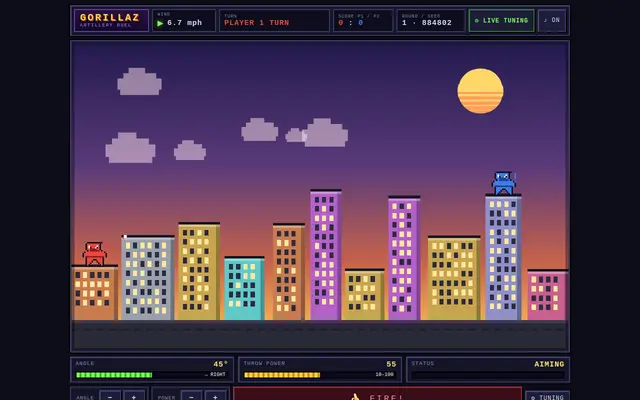
Gorillaz
Mimo v2.6 Flash
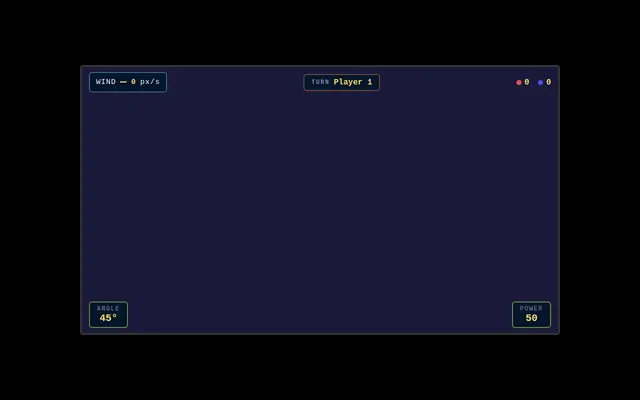
Gorillaz
solar mini4
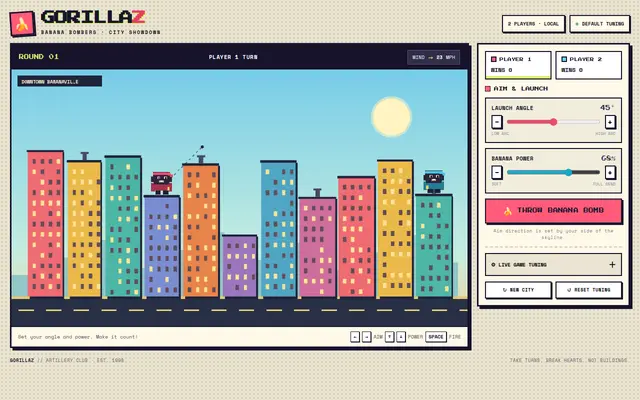
Gorillaz
GPT 6 Luna
Gorillaz
MiMo V2.6 Distill Qwen 9B GGUF

Gorillaz
MiMo V2.6 Distill Qwen 9B GGUF
Gorillaz
Deepseek v4.1 Flash
Gorillaz
Qwen 3.8
Gorillaz
Tiel Coder 35B A3B GGUF MTP
Gorillaz
GLM 5.3 Flash

Gorillaz
Ornith 1.5 35B A3B
Gorillaz
muse spark 1.2 contributor
Gorillaz
Qwen 3.8 27B GGUF XL
Gorillaz
Qwen 3.8 27B GGUF