Node Graph Editor
Read the current prompt
# Task: Build a Logic Circuit Node-Graph Editor

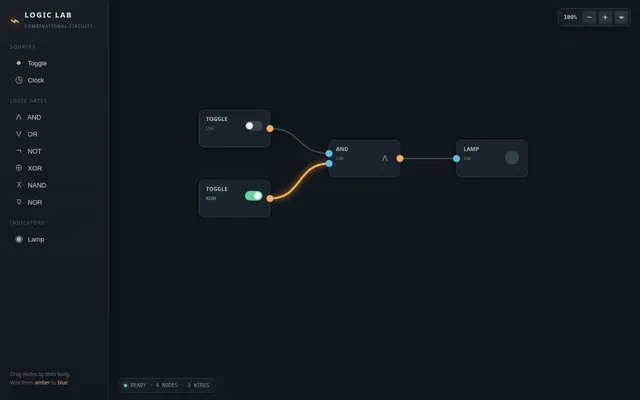
Build an interactive node-graph editor (vanilla JS, no external assets, no CDN, no libraries) where users wire logic gates together and watch signals flow live. The top priority is **correct graph interaction and evaluation** — dragging wires must feel precise, and the circuit must compute the right answer every time.

## Core Specification

**Canvas & Viewport**
- An infinite pannable canvas: drag empty space to pan, mouse wheel to zoom toward the cursor (50%–200%)
- Nodes and wires live in world coordinates; all hit-testing stays accurate at every zoom level
- Subtle dot grid that pans/zooms with the world

**Nodes**
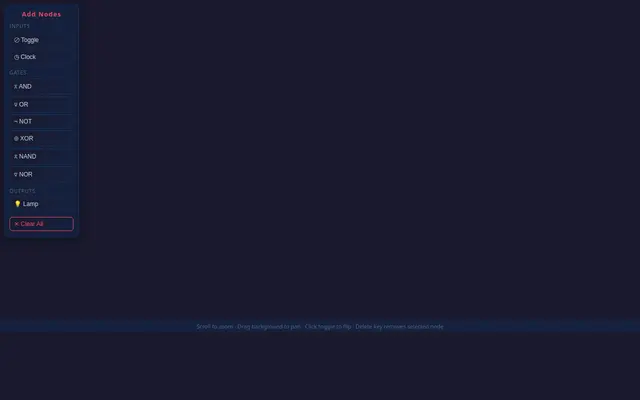
- **Inputs:** Toggle switch (click to flip on/off), Clock (pulses at a selectable rate)
- **Gates:** AND, OR, NOT, XOR, NAND, NOR — each with the standard truth table
- **Outputs:** Lamp (glows on), plus a 7-segment-style digit display driven by 4 input bits (binary → hex digit) if you want a stretch goal
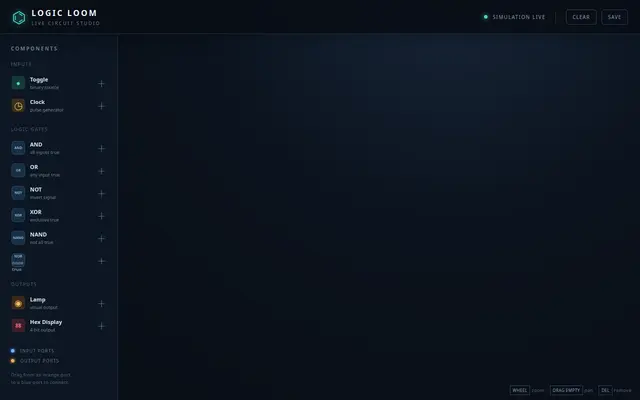
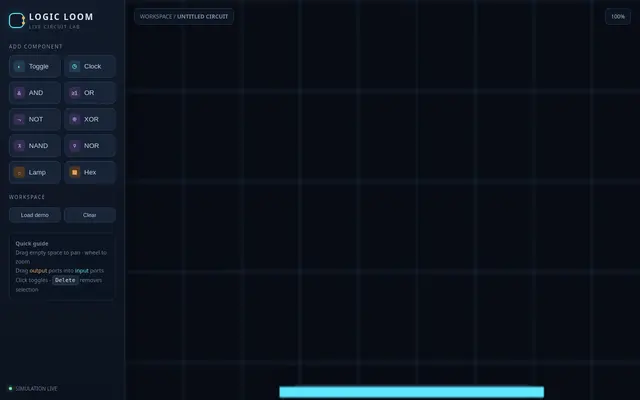
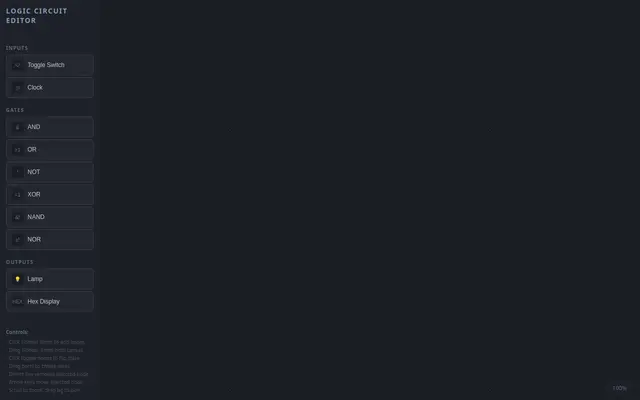
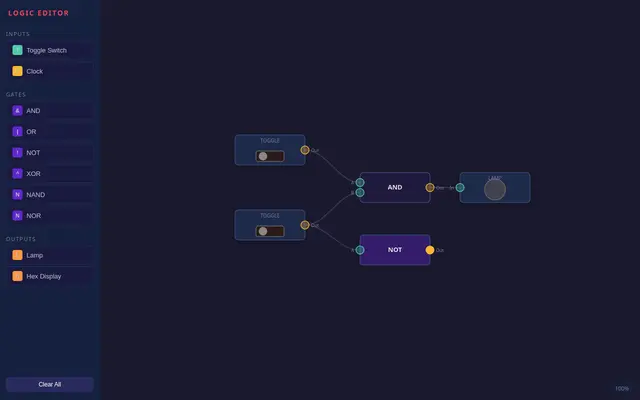
- Palette (sidebar or right-click menu) to add nodes; drag nodes by their body to move them; Delete key removes the selected node and all its wires
- Every node shows its name and a live on/off state tint; input/output **ports** are clearly visible circles on the left/right edges

**Wires**
- Drag from an output port to an input port to connect; dragging from an occupied input port picks up the existing wire to re-route it
- Live wire preview follows the cursor while dragging, snapping/highlighting when over a valid target port
- Wires render as smooth bezier curves; energized wires glow, de-energized wires are dim
- Type rules: one wire per input port (connecting to an occupied port replaces the old wire); outputs fan out freely
- **Cycle rejection:** a connection that would create a feedback loop must be refused with a clear visual cue (red flash on the wire) — combinational circuits only

**Evaluation Engine**
- Propagate signal changes reactively: toggling an input re-evaluates only downstream nodes, in topological order
- Evaluation must converge in a single pass per change (topological evaluation, not iterate-until-stable guessing)
- Clock nodes tick on a timer and re-trigger evaluation of their downstream graph each pulse
- No evaluation glitches when wiring or unwiring mid-simulation

**Persistence**
- The full graph (nodes, positions, wires, toggle states, clock rates) serializes to `localStorage` and restores exactly on reload

## Visual Style
- Dark, instrument-panel aesthetic: rounded node cards with subtle depth, color-coded ports (inputs cool, outputs warm), glowing wires and lamps
- Hover states on every interactive element (ports enlarge, nodes lift slightly)
- Clean and legible at both zoom extremes — port hit targets must stay comfortable

## Technical Requirements
- Vanilla JS with HTML5 Canvas or SVG for the graph surface; all code organized with clear section comments
- Clean data model: a serializable scene of `{ nodes: [{ id, type, x, y, state }], wires: [{ from, fromPort, to, toPort }] }` — rendering, hit-testing, evaluation, and persistence all derive from it
- Tunable constants block at the top (colors, zoom limits, port radius, hit tolerance, clock rates)
- Target: smooth panning/dragging with 50+ nodes and live evaluation

## Quality Bar (must hit all)
- Every gate computes its standard truth table; a 3-gate chain updates end-to-end on one input toggle
- Zoom-to-cursor: the world point under the cursor stays under the cursor while zooming
- Port snapping and wire hit-testing are accurate at 50% and 200% zoom
- A cycle attempt (e.g. NOR feeding its own input through an inverter chain) is rejected, not hung on
- Reload restores the exact circuit, including toggle states and wire routing

## Self-Check Before Finishing
Verify with the browser tools:
- Build: Toggle → AND(1) with Toggle → NOT → Lamp; flip each toggle and assert the lamp matches the truth table both ways
- Re-wire an occupied input port and confirm the old wire is gone and evaluation reflects the new source
- Attempt to wire an output back into an upstream input of its own chain — must be refused
- Zoom in fully, drag a wire between two distant ports — the drop must land on the port under the cursor
- Reload the page and confirm the circuit is restored and still evaluating
Recent highlights
Latest results
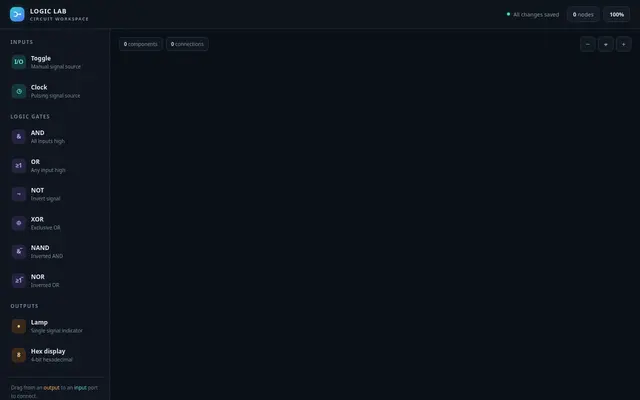
Node Graph Editor
GPT 6 Luna
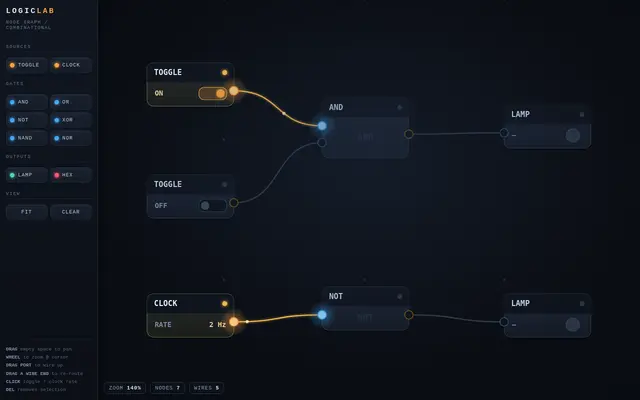
Node Graph Editor
Deepseek v4.1 Flash
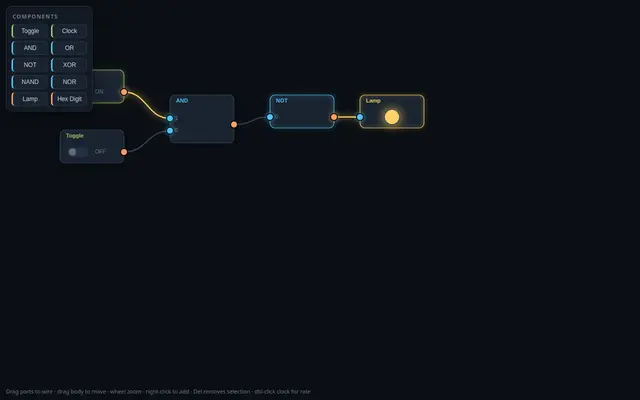
Node Graph Editor
GLM 5.3 Flash
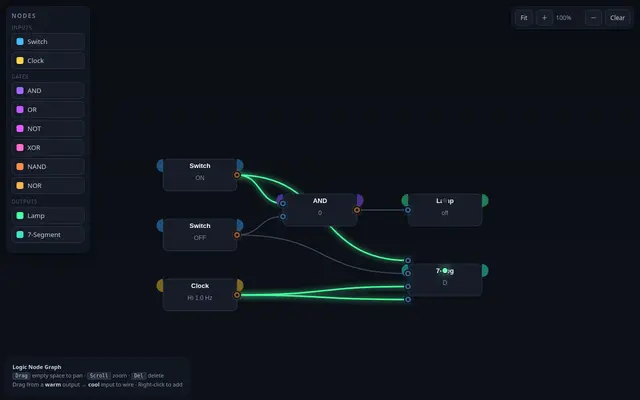
Node Graph Editor
Ornith 1.5 35B A3B
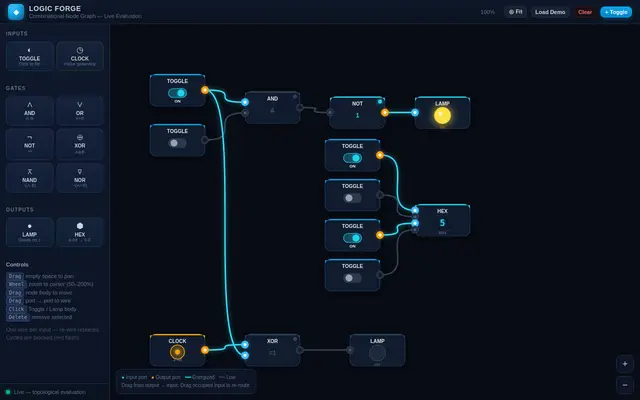
Node Graph Editor
muse spark 1.2 contributor
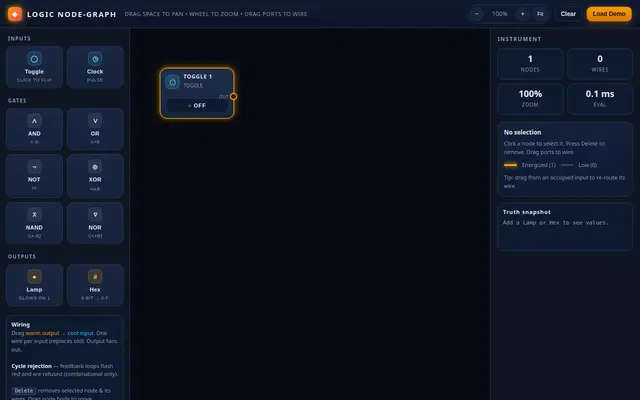
Node Graph Editor
muse spark 1.2
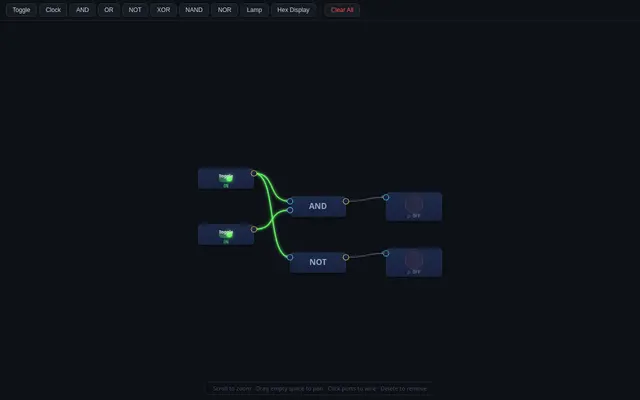
Node Graph Editor
Qwen 3.6 27B MTP GGUF

Node Graph Editor
lfm2 24b a2b
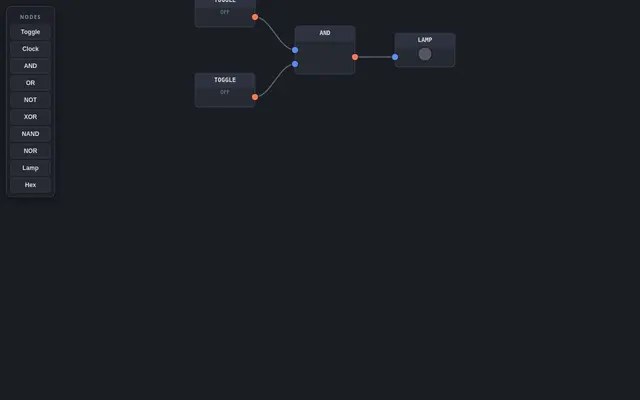
Node Graph Editor
thinkingcap qwen3.6 27b
Node Graph Editor
GPT 5.6 terra
Node Graph Editor
GPT 5.6 Luna Pro
Node Graph Editor
GPT 5.6 Luna Pro
Node Graph Editor
Qwen 3.6 27b MTP
Node Graph Editor
Qwen 3.6 27b MTP
Node Graph Editor
Qwen 3.6 27b MTP