Physics Playground
Read the current prompt
# Task: Build a 2D Soft-Body Physics Playground

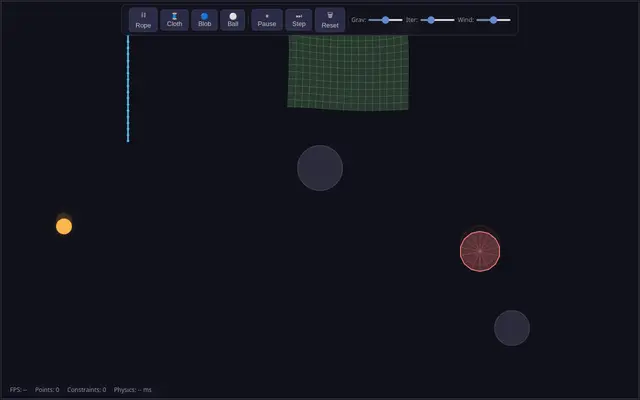
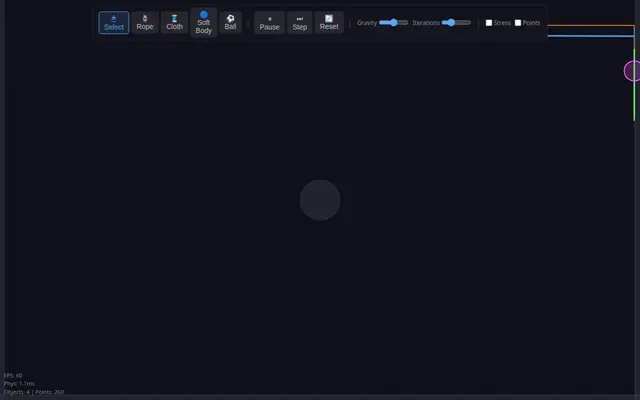
Build an interactive 2D physics playground (vanilla JS, no external assets, no CDN, no libraries) based on **Verlet integration with constraint relaxation** — ropes, cloth, and soft bodies the user can grab, tear, and spawn. The top priority is **numerical stability** — a physics toy that explodes, jitters, or tunnels is a failed physics toy.

## Core Specification

**Engine (write it yourself — position-based dynamics, not a rigid-body library clone)**
- Verlet integration: `x' = x + (x - xPrev) * damping + a * dt²` with a **fixed timestep** accumulator (e.g. 60 Hz physics) decoupled from render rate
- Constraint solving via relaxation: distance constraints iterated N times per step (N configurable, ~3–8)
- Collision: points vs. static shapes (bounding walls/floor, a few static circles/boxes) with friction; simple point-vs-point collision optional
- Gravity toggle and strength slider; optional wind
- No `NaN` escapes: guard division-by-zero in constraint resolution (zero-length links, coincident points)

**Spawnable Objects (toolbar + click/drag to place)**
- **Rope:** click-drag to draw a hanging chain of N points pinned at the start
- **Cloth:** draggable rectangle of points with structural + shear constraints, pinned along the top edge (pin pattern selectable: both corners / full edge)
- **Soft body:** circle/blob or box of points with edge + internal brace constraints that holds shape but deforms on impact
- **Ball:** single point with radius that bounces
- Spawn several objects; they coexist and interact with static geometry

**Interaction**
- **Grab:** click near any point to grab it (nearest point within a radius); drag to move it, it follows the cursor with the constraint solver reacting live; release to throw with the drag velocity
- **Tear/cut:** right-drag (or hold a modifier) to slice through constraints — cloth rips along the cut line, ropes split
- **Pin/unpin:** click a point with a modifier to toggle a pin in place
- Pause/step controls (Space to pause, arrow to step one physics frame while paused), reset button, gravity and iterations sliders

**Rendering**
- Canvas 2D: constraints as lines, points as small dots (hidden by default for cloth — render cloth as a filled mesh or grid lines), soft bodies as filled polygons
- Optional stress visualization: color constraints by stretch ratio (green → red)
- FPS counter and physics-step time readout

## Visual Style
- Dark playground with vibrant materials (each object type a distinct hue), subtle floor/wall rendering
- Satisfying feel: slight motion blur trail optional, cursor grab highlight, tear effect
- Toolbar minimal and out of the way — the canvas is the app

## Technical Requirements
- Vanilla JS, Canvas 2D; all code organized with clear section comments
- Fixed-timestep accumulator with a maximum frame delta clamp (tab-switch must not explode the sim)
- Tunable constants block at the top (gravity, damping, iterations, timestep, tear radius, colors)
- Target: stable 60 FPS with ~1000 constraint points

## Quality Bar (must hit all)
- A pendulum rope swings smoothly and settles; cloth hangs from pins and drapes over a static circle without exploding or self-intersecting into chaos
- Leaving the tab for 30 seconds and returning does not detonate the simulation
- Grabbing and whipping a cloth corner produces a believable wave; releasing throws it
- Tearing a rope in the middle leaves two independently swinging halves
- No visible jitter on resting stacks; energy visibly decays (nothing oscillates forever)

## Self-Check Before Finishing
Verify with the browser tools (expose the sim on `window` — e.g. `sim.points`, `sim.step()` — so it can be probed headlessly):
- Drop a soft body from height with gravity on: after settling (~3s of stepped time), its total kinetic energy is near zero and no point is below the floor
- Step the sim 1000 frames and assert no coordinate is `NaN` or beyond a sane bound
- Pin two cloth corners, step 600 frames, assert the cloth's lowest point stays above the floor and the top pins haven't moved
- Tear a rope constraint via the exposed model, step, and assert the halves move independently
Recent highlights
Latest results
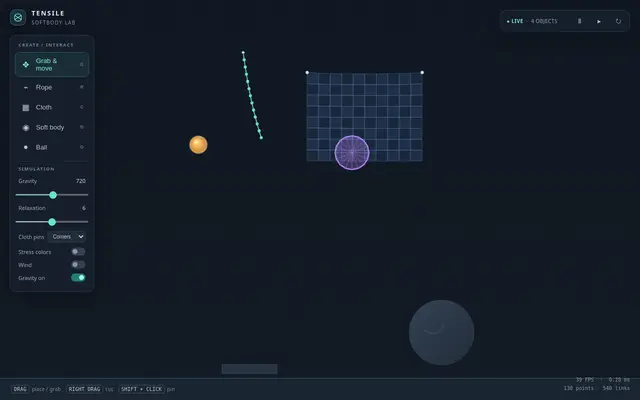
Physics Playground
GPT 6 Luna
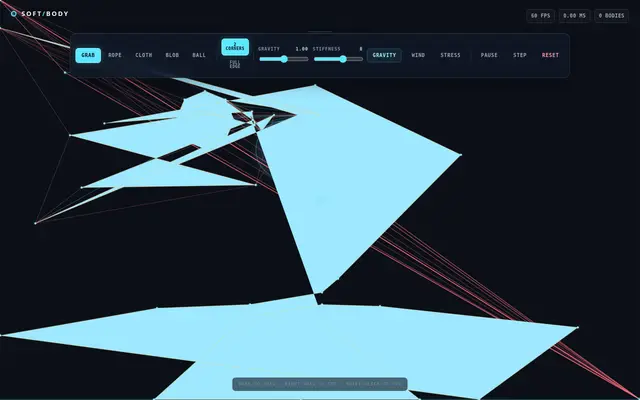
Physics Playground
nex agi Nex N2.5 mini GGUF
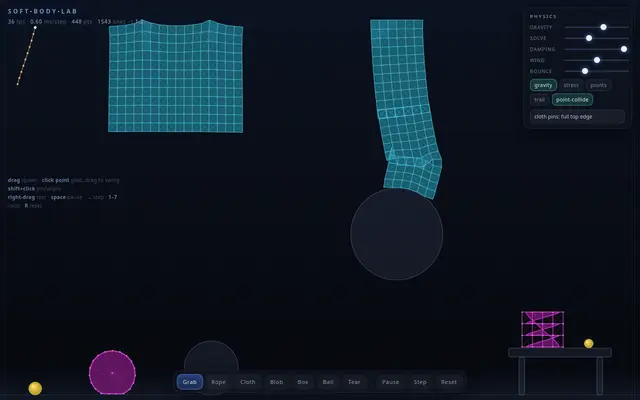
Physics Playground
Deepseek v4.1 Flash
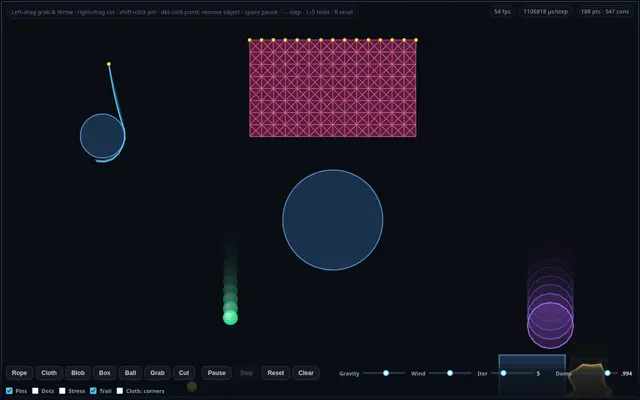
Physics Playground
Qwen 3.8
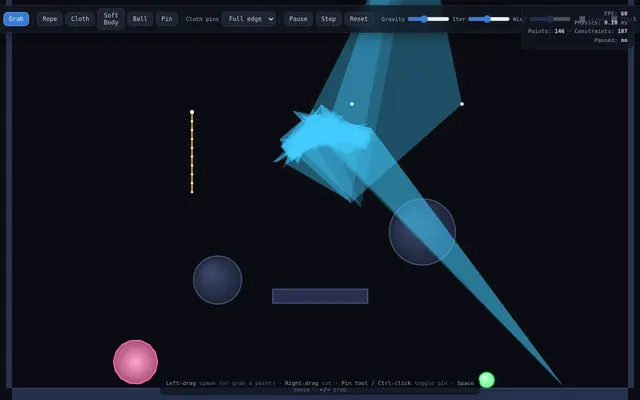
Physics Playground
Tiel Coder 35B A3B GGUF MTP
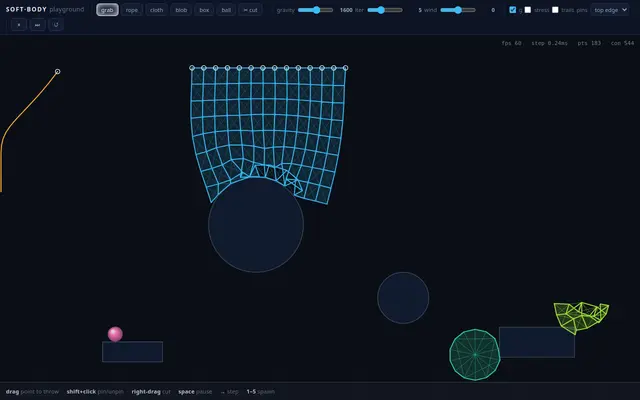
Physics Playground
Qwen 3.8
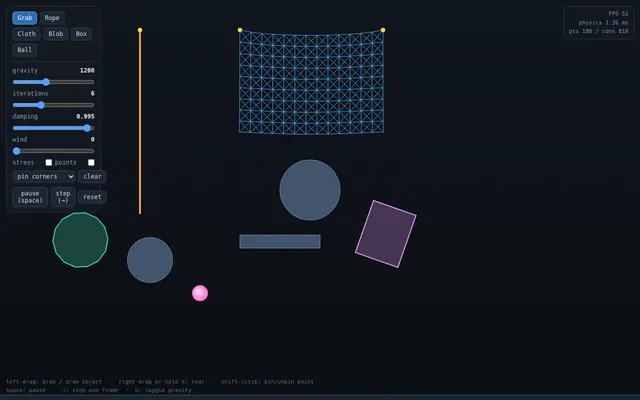
Physics Playground
GLM 5.3 Flash
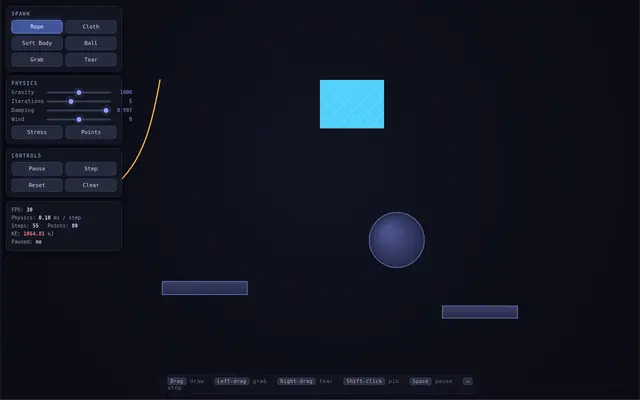
Physics Playground
Ornith 1.5 35B A3B
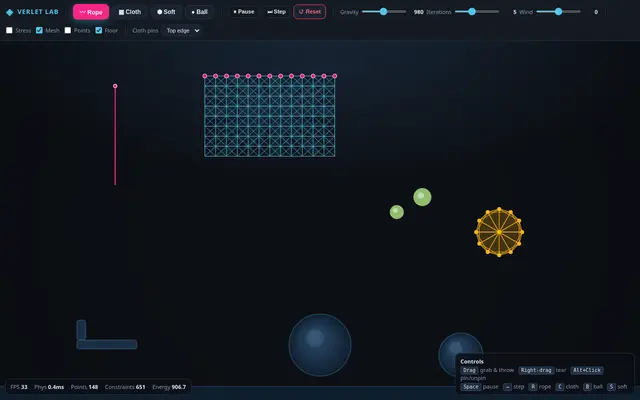
Physics Playground
muse spark 1.2 contributor
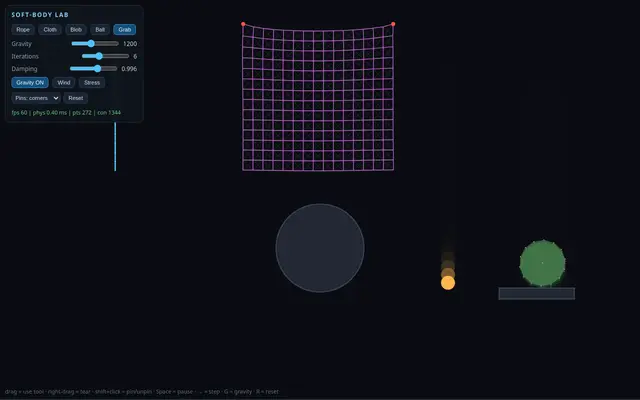
Physics Playground
ox alpha
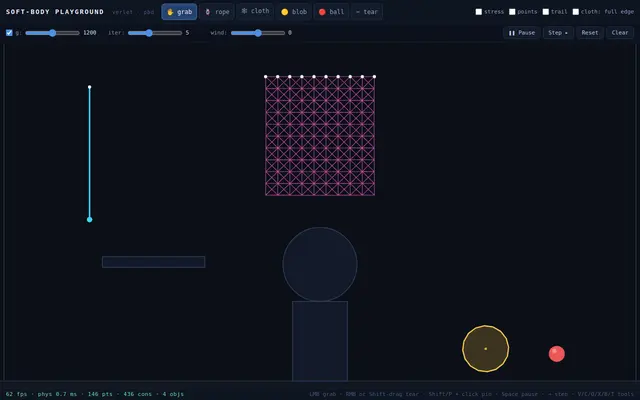
Physics Playground
Qwen 3.8 27B GGUF
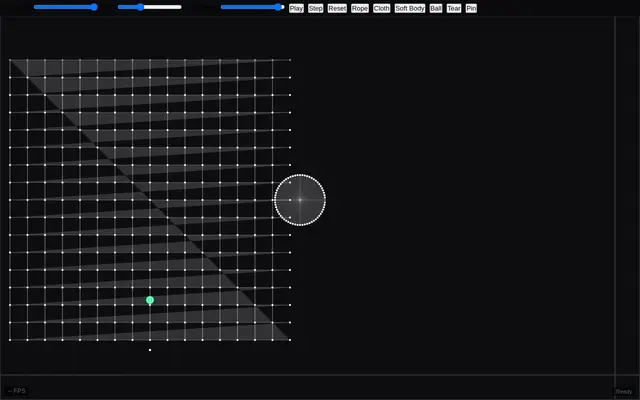
Physics Playground
ling 3.0 tiny:free
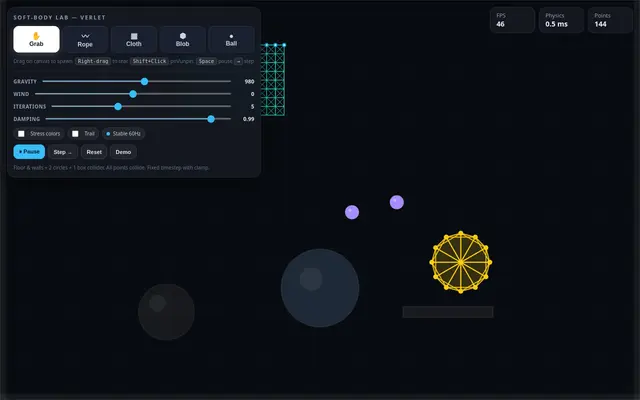
Physics Playground
muse spark 1.2
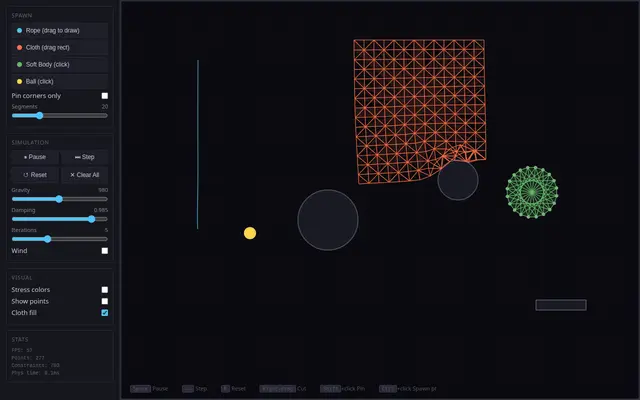
Physics Playground
Qwen 3.6 27B Fable Fusion 711 Uncensored Heretic NM DAU NEO MAX MTP GGUF
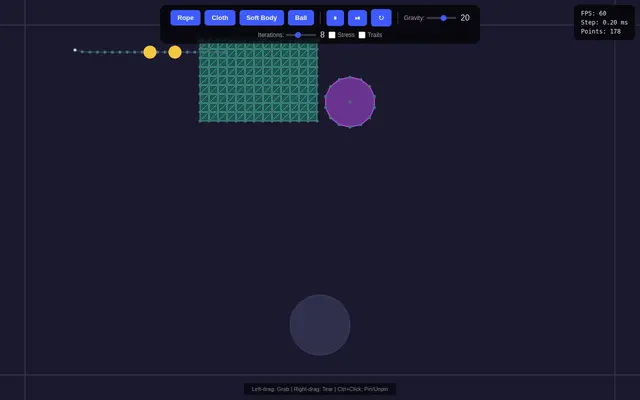
Physics Playground
Qwen 3.5 122b a10b
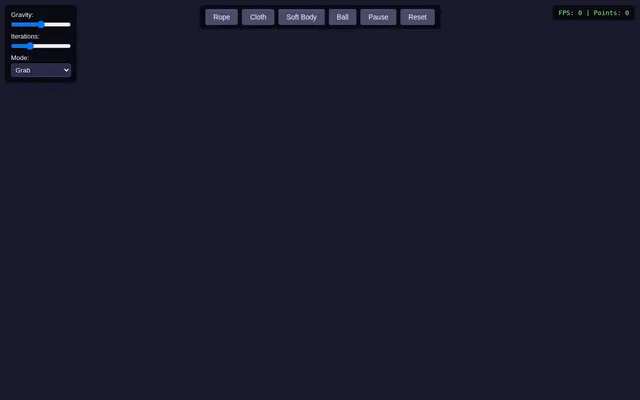
Physics Playground
Qwen 3.5 122B A10B MTP GGUF
Physics Playground
Qwen 3.6 27B MTP GGUF IQ4 NL
Physics Playground
ThinkingCap Qwen3.6 27B GGUF